
Make an appointment
When it comes to your health, you deserve quality service. You can rely on our team for your medical examinations. To make an appointment, contact our team by phone, fax or click the “Make an appointment” link.
819 820-2827
Fax: 819 563-3542
Osteodensitometry
Osteodensitometry (bone density test) is a simple, rapid and non-invasive medical procedure that measures bone mineral density. This test is essential for assessing bone health and detecting conditions such as osteoporosis at an early stage, thereby reducing the risk of serious fractures.
Why have a bone density test?
With age or certain medical conditions, bones can become more fragile.
Osteodensitometry is used to:
- Diagnose osteoporosis before a fracture occurs.
- Assess the risk of fracture.
- Monitor changes in bone density over time, particularly after medical treatment.
There are a number of risk factors that can lead to a diagnosis of osteoporosis and justify the need for a bone density test:
- Women over 65
- Men over 70
- People with a family history of osteoporosis
- Individuals with fractures after age 50
- Patients taking treatments that may affect bone density (e.g. corticosteroids)
Preparation for the test
Pre-examination instructions:
- Do not take any calcium supplements for 48 hours prior to the examination.
- Avoid undergoing nuclear medicine or a barium swallow for 10 days prior to the procedure.
- You do not need to change your diet.
On the day of your appointment, please bring:
- The original medical prescription signed by the requesting professional
- Your valid health insurance card
The Osteodensitometry Procedure
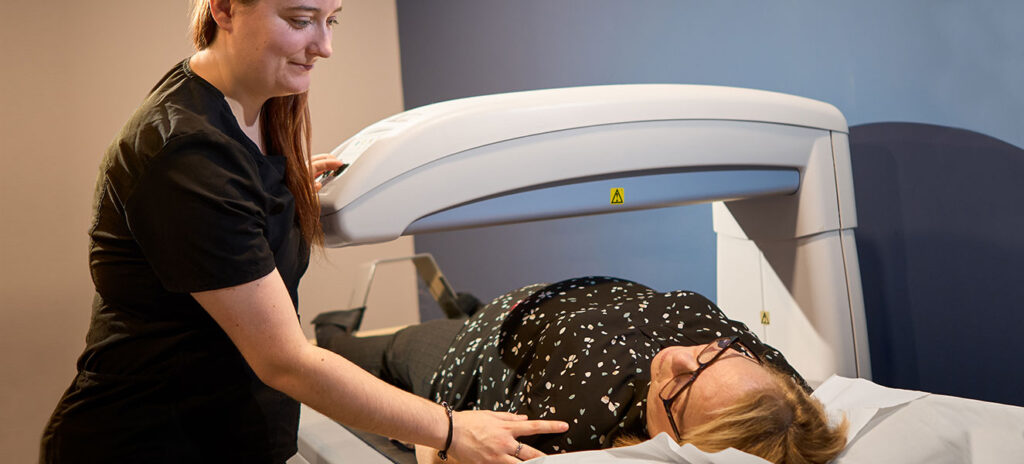
The bone density test is quick (about 15 minutes), painless and requires no special preparation. You will be asked to lie on a table while low-energy beams are used to measure the density of your bones, usually in the spine, hips or wrists.
Precautions and contraindications
Although osteodensitometry is a safe and painless procedure, certain precautions must be taken:
Pregnant women: The test uses very weak X-rays, which are contraindicated during pregnancy to protect the fetus.
Presence of metal in the examined area: Metal implants (such as hip replacements) may interfere with the results. Inform your physician or technologist before the examination.
Recent tests with contrast product: If you have had a test with contrast product (e.g. CT scan or scintigraphy), it is recommended to wait 7 to 10 days before an osteodensitometry test to avoid any interference.
If in doubt, discuss your situation with your doctor before scheduling the test.
Fees
Bone densitometry is a service covered by the Régie de l’assurance maladie du Québec (RAMQ).
To view the rates for all the procedures we perform, we recommend that you consult our fee schedule. You can also check RAMQ’s coverage of examination costs.
FAQ
Do you have questions about the bone densitometry examination? Visit our FAQ to learn more about this medical exam.
Do I need to undress for bone densitometry?
It is not necessary to undress completely for a bone density test, but you will have to remove your clothes that have metal (buttons, zippers, staples, bra ribs) at the level of the lumbar spine and hips.
What are the first symptoms of osteoporosis?
Osteoporosis is often asymptomatic in its early stages. Most often, the disease is revealed by a first fracture, which occurs during a shock or a minor fall. However, other signs may appear as the disease progresses:
- Bone pain
- Loss of height (often several centimetres).
- Stooped posture or bump in the upper back.
How often should a bone density test be performed?
The frequency of bone densitometry depends on your age, risk factors and previous examination results. If the density is normal or bone loss is benign, the examination is usually repeated every 3 to 5 years in people over 65, especially if no risk factors are added.
More frequent follow-up may be required if you are taking medication, such as corticosteroids. If you are on treatment for osteoporosis, your doctor may prescribe a test after 1 or 2 years to assess the effectiveness of the treatment.
Any questions?
Contact us