
Make an appointment
When it comes to your health, you deserve quality service. You can rely on our team for your medical examinations. To make an appointment, contact our team by phone, fax or click the “Make an appointment” link.
819 820-2827
Fax: 819 563-3542
2D and 3D Mammography (Tomosynthesis)
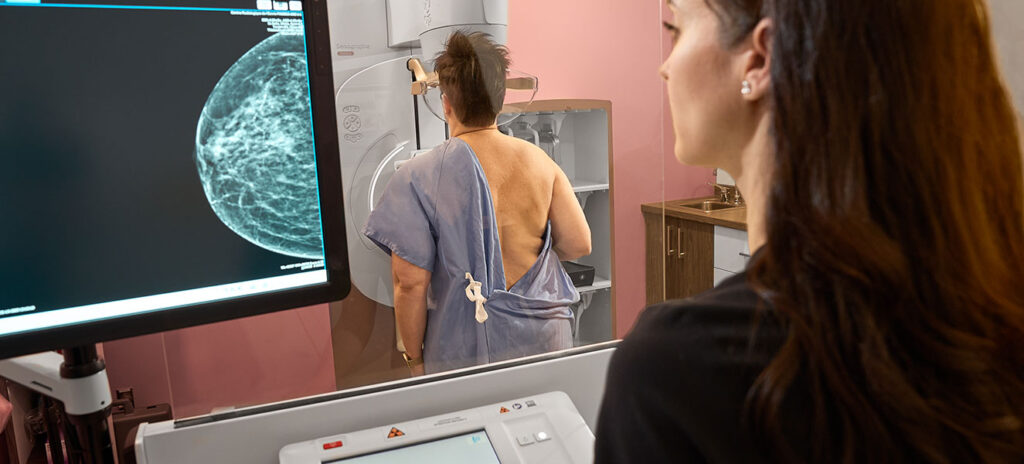
Mammography is a medical imaging technique that uses low doses of X-rays to examine breast tissue. It can be used to diagnose and/or screen for breast cancer. This examination can reveal breast cancer at an early stage in women who are not showing signs of cancer. It can therefore help improve survival rates for women with breast cancer.
Our state-of-the-art equipment allows us to offer 2D or 3D mammography (tomosynthesis). Tomosynthesis is approved by Health Canada. For some patients, it is a better screening tool for breast cancer and reduces the need for additional tests.
Description
There are generally two types of mammograms, one to make a diagnosis and the other to screen for cancer.
Breast cancer screening centre
Are you a woman between the ages of 50 and 74? The Québec Breast Cancer Screening Program (PQDCS) is for you. The Estrie Radiology Centre is a designated screening centre for this program.
Why have a mammogram?
Mammography plays a crucial role in the prevention and early treatment of breast disease. It can:
- Confirm or rule out an abnormality detected by palpation or ultrasound.
- Detect breast cancer at an early stage. The earlier the disease is diagnosed, the better the chances of treatment and cure.
- Monitor breast changes over time in patients with a family or personal history.
Preparation for the test
- On the day of the test, don’t put any powder, cream, perfume or deodorant on your breasts or underarms.
- If you have sensitive breasts, avoid coffee, tea, chocolate and soft drinks for two weeks before the mammogram. If necessary, you can take an analgesic, as you would when you have mild pain.
At the time of your appointment, make sure you have:
- The original medical prescription signed by the requesting professional and/or the letter from the PQDCS
- Your valid health insurance card
- Images on CD (or another digital device) and copies of previous test reports
Notify your technologist of the presence of breast prostheses.
The Mammography Procedure
Mammography is generally a quick procedure that takes just a few steps.
- You will need to remove any clothing covering your upper body, as well as any jewelry or metal objects.
- A technologist will place your breasts, one at a time, between two plates to obtain clear images of the mammary gland. This compression, though uncomfortable, is necessary to improve image quality.
- Before you leave, the technologist will check the quality of the radiology images. If necessary, additional images will be taken.
The procedure lasts approximately 15 to 20 minutes, and the images are then analyzed by a radiologist.
Precautions and contraindications
Mammography is a safe and widely used test, but there are certain precautions to be taken.
- Pregnancy and breastfeeding: If you are pregnant or breastfeeding, mammography is not generally recommended, unless absolutely necessary, to avoid unnecessary exposure to X-rays.
- Breast pain or tenderness: If you have tender breasts, schedule the procedure about a week after your period to minimize discomfort.
Discuss any special conditions with your physician or technologist before the examination.
Fees
Mammography is a service covered by the Régie de l’assurance maladie du Québec (RAMQ).
To view the fees for all the procedures we perform, please consult our fee schedule. You can also check whether procedure fees are covered by the RAMQ.
FAQ
Do you have questions about mammography? Here we have collected answers to the most common questions to help you prepare and better understand this important exam.
At what age should you have your first mammogram?
The Quebec Breast Cancer Screening Program recommends having a screening mammogram every two years starting at age 50.
For women at average risk, the first mammogram is generally recommended between the ages of 40 and 50. In cases of high risk (family history or genetic predisposition), a mammogram is often recommended earlier, and the follow-up schedule is determined by a doctor.
It is recommended that you consult with a healthcare professional to assess your individual risk.
How often should you have a mammogram?
A screening mammogram is generally recommended every 2 years for asymptomatic women between the ages of 50 and 74. The frequency may vary depending on individual circumstances. If there is a family history of breast cancer, a mammogram is often recommended annually starting at age 40. If symptoms are present, a diagnostic mammogram is ordered, and the frequency of follow-up is determined by the doctor.
What are the risks of a mammogram?
A mammogram is not a dangerous procedure, and the benefits of early detection far outweigh the risks involved. However, like any medical procedure, it has limitations and drawbacks.
X-ray exposure: Mammograms use X-rays, which involve a very low dose of radiation. Medical authorities consider the risk of developing cancer as a result of this exposure to be virtually nonexistent or negligible.
Discomfort: The compression of the breast, which is necessary to obtain clear images and reduce the radiation dose, can be painful or uncomfortable, although it lasts only a few seconds.
If you have any concerns or experience unusual symptoms, it is always advisable to discuss them with your doctor.
Can you have a mammogram while you’re pregnant?
If you are pregnant or breastfeeding, mammograms are generally not recommended to avoid unnecessary exposure to X-rays, unless absolutely necessary.
How long does a mammogram take?
A mammogram is a quick examination that takes about 15 to 20 minutes.
Why have an ultrasound after a mammogram?
An ultrasound is often performed after a mammogram to better characterize an abnormality that has been detected or to examine areas that are difficult to analyze when the breasts are very dense. If a suspicious image is found, the ultrasound helps to more accurately assess the nature of the lesion and guides the radiologist in analyzing its shape and contours.
What are the advantages of a 3D mammography compared to a conventional mammography?
A 3D mammogram (tomosynthesis) outperforms a conventional 2D mammogram by capturing multiple images from different angles. Its main advantages include improved detection of breast cancer and a reduction in follow-up exams. The 3D method allows for visualization through dense tissue that can obscure small tumors and can also detect masses or microcalcifications earlier, improving the detection of invasive cancers.
The exam is performed in the same way as a standard 2D mammography and uses similar doses of X-rays.
Is a mammography covered by health insurance
Yes, mammograms are covered by the Régie de l’assurance maladie du Québec (RAMQ). There are no fees if the following conditions are met:
Diagnostic or on-demand mammogram: Covered annually with a doctor’s prescription.
Screening mammogram (for women aged 50 to 74): Covered every 2 years under the Quebec Breast Cancer Screening Program (PQDCS).
Any questions?
Contact us