
Make an appointment
When it comes to your health, you deserve quality service. You can rely on our team for your medical examinations. To make an appointment, contact our team by phone, fax or click the “Make an appointment” link.
819 820-2827
Fax: 819 563-3542
Magnetic Resonance (MRI)
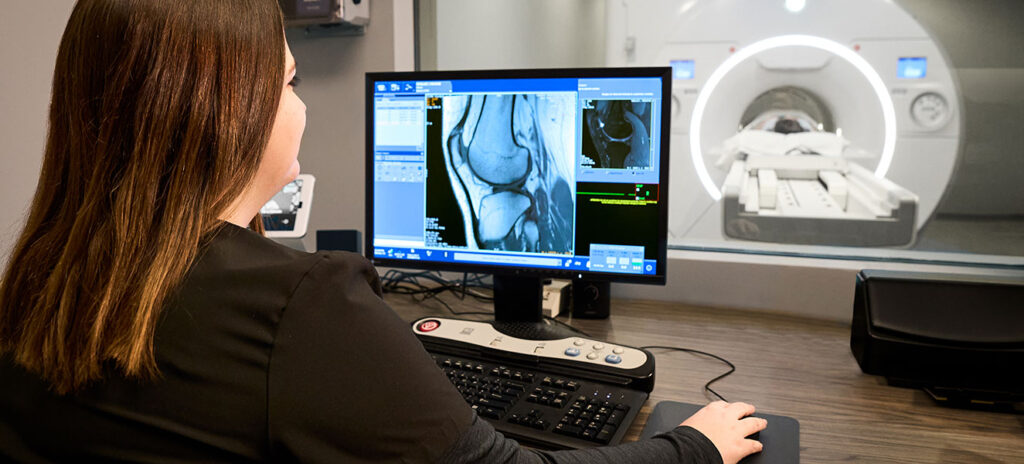
Magnetic Resonance Imaging (MRI) is an advanced medical imaging method that uses magnetic fields and radio frequency waves to produce detailed images of internal organs, tissues and structures. Its accuracy makes it an essential tool for diagnosing a wide range of medical conditions. Some MRI examinations require a contrast medium to provide a more complete examination. No ionizing radiation is used in MRI.
We also offer MRI arthroscopic imaging. This exam involves capturing images of your joints after injecting a contrast agent into your joint space.
Why have an MRI?
An MRI is particularly useful for visualizing soft tissues and detecting abnormalities that other imaging techniques, such as X-ray or CT scan, might now show. It is commonly used for:
- Planning surgical interventions by providing precise images of the area concerned.
- Exploring unexplained pain or abnormalities in the brain, spine, joints or internal organs.
- Diagnosing and monitoring diseases such as tumors, lesions, neurodegenerative diseases or vascular anomalies.
Main Types of MRI
- Brain MRI
- Knee MRI
- Pelvic MRI
- Abdominal MRI
- Spinal MRI
- Shoulder MRI
- Hip MRI
- Arthro-MRI
Preparation for the test
There is no specific preparation for MRI, but we advise you to follow your doctor’s instructions carefully.
If you have to get an abdominal MRI, you will need to fast for at least 4 hours before the test.
At the time of your appointment, please make sure you have:
- your valid health insurance card
- the original medical prescription signed by the requesting professional
The MRI procedure
An MRI is a painless examination that can last from 20 to 60 minutes, depending on the area being examined. Please note, however, that it may also take longer. The test takes place in several stages.
- If contrast product is used, it will be administered by intravenous or intra-articular injection to improve visibility of internal structures.
- You must remove all metallic objects (jewelry, glasses, etc.) and wear a gown.
- During the examination, you may hear clicking or pulsing noises. Earplugs or headphones will be provided to reduce noise discomfort.
Precautions and contraindications
Although MRI is a safe, non-invasive technique, certain precautions must be taken:
Allergies to the contrast product: If a contrast product is required (gadolinium), tell the medical team of any allergy or kidney problem.
Presence of metal implants: Metal objects (such as pacemakers, heart valves, prostheses or metal splinters) can be affected by magnetic fields. Please inform us of any prior surgery or implants.
Pregnancy: Although MRI is generally considered to be safe during pregnancy, it is avoided during the first trimester except in the case of an urgent medical need.
Claustrophobia: The MRI scanner can be narrow. Options such as open MRI or mild sedation may be considered if necessary.
Fees
Magnetic resonance imaging is not a service covered by the Régie de l’assurance maladie du Québec (RAMQ). Please refer to our fee schedule to find out the cost of each MRI examination. Please check your insurance coverage, as several examinations are reimbursed by private and group insurances, as well as by the SAAQ and CNESST (if the examination is required by one of these two organizations).
FAQ
The MRI may raise questions before your exam. Discover our FAQ section to find out everything about the preparation, process and precautions to take for this specialized exam.
What does an MRI look like?
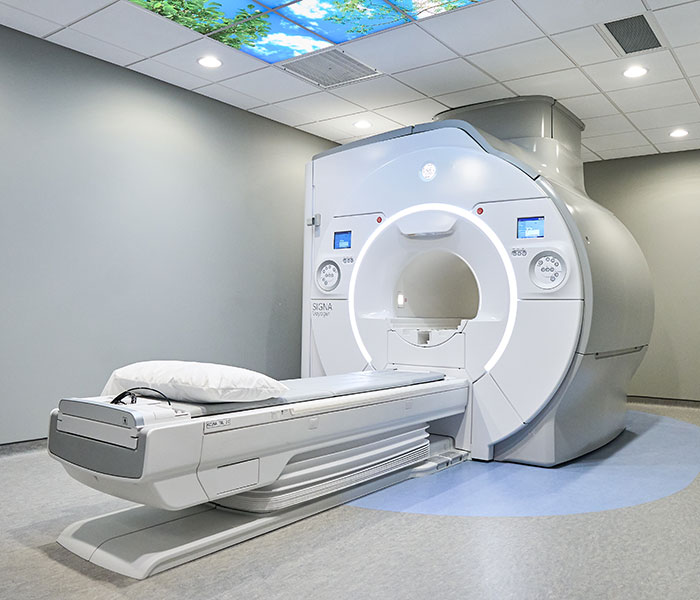
The MRI scanner looks like a long tube open at both ends, with a sliding table that moves inside the tunnel during the examination. Depending on the part of the body being examined (for example, a knee or an ankle), your head may not be inside the machine. The scan is painless and requires you to remain completely still.
The device does not emit radiation, but it produces loud tapping and clanking noises. The medical team will provide you with headphones to attenuate the sound. A two-way communication system and an emergency handle are always available so you can signal any discomfort during the exam.
What is the difference between a scan and an MRI?
The CT scan and MRI are radiology examinations that use distinct technologies and allow diagnosing different medical conditions. The scan (computed tomography) is a quick test that uses X-rays, ideal for seeing bones, dense structures or trauma. MRI uses a magnetic field and radio waves, making it more suitable for examining soft tissues (such as the brain, muscles, and ligaments) without exposing the patient to radiation.
How many MRIs can you have per year?
Since magnetic resonance imaging does not use X-rays, there is no medical limit to the number of MRI scans you can have per year. The frequency is determined by your doctor, based on what he or she deems necessary to diagnose or monitor a condition.
Do you need to fast before an MRI?
You do not need to fast for most MRI exams. However, it is necessary to be fasting for at least 4 hours before an abdominal MRI.
Do I need to undress for an MRI?
For safety reasons and to ensure image quality, you will be asked to remove your clothes and wear a gown for the MRI. You must remove all metal objects (watches, jewelry, glasses, etc.), as these can interfere with the machine.
How long does an MRI take?
An MRI can take from 20 to 60 minutes, depending on the area being examined. The examination may take longer, especially if a contrast agent needs to be injected.
What conditions can an MRI detect?
An MRI can detect conditions affecting soft tissues, organs, and the nervous system. It is particularly effective at identifying neurological disorders, cancers, joint abnormalities, and pelvic diseases.
What are the possible side effects of an MRI?
An MRI does not use radiation, so it is safe for the body. The exam itself does not cause any side effects, but some discomfort may occur depending on how the procedure is conducted:
Related to the machine: Being confined in the narrow tunnel may cause a feeling of claustrophobia in some patients.
Without contrast agent: The exam is painless. You may feel slightly tired after the exam, as well as a local sensation of warmth or discomfort due to the noise of the machine.
With contrast agent (gadolinium): Temporary effects may occur in the hours following the injection, such as a metallic taste in the mouth, nausea, mild headaches, or dizziness. Allergic reactions are rare and generally minor.
How much does an MRI cost in the private sector?
To find out the cost of our various MRI exams, please refer to our fee schedule. Many exams are covered by private insurance plans or group insurance.
What is the purpose of using a contrast agent during an MRI?
The use of a contrast agent (most often gadolinium-based) during an MRI allows for better visualization of the organs and a more accurate diagnosis. Injected intravenously, it enhances the contrast between healthy tissue and abnormalities, which absorb the contrast agent differently. Its use highlights lesions or areas of inflammation and helps determine the extent of a condition. The injection of a contrast agent is not routine and depends on the doctor’s recommendation.
Any questions?
Contact us